The World's Most Fascinating Natural Wonders
No architect designed them and no engineer built them. Shaped by water, wind, fire and time, these are the places that remind us how astonishing our planet really is.
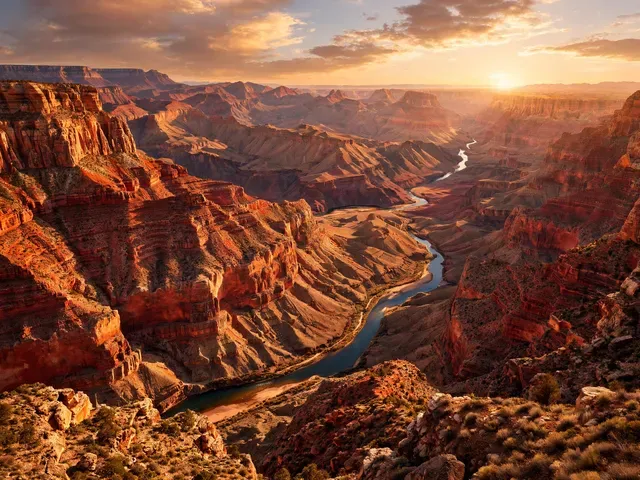
Every continent has landscapes that stop travellers in their tracks. Some took millions of years to form, grain by grain and layer by layer. Others appear for a few hours on a winter night and then vanish. What they share is scale: standing before them, our own lives feel wonderfully small. Here is a journey through some of the most fascinating natural wonders on Earth, and the stories behind them.
The Grand Canyon — a book written in rock
The Grand Canyon in Arizona stretches about 446 kilometres long, up to 29 kilometres wide, and more than 1,800 metres deep. The Colorado River carved it over roughly five to six million years, cutting through rock layers that are themselves up to two billion years old. Geologists read those coloured bands like pages in a book: each stripe is an ancient sea, desert or riverbed, preserved in stone.
What surprises most first-time visitors is not just the size but the light. At sunrise and sunset the cliffs shift through shades of red, orange and purple, and shadows reveal ridges that were invisible at noon. Whether you gaze from the rim or hike down toward the river, the canyon teaches the same lesson — patience, applied by nature over immense time, can sculpt something no human tool could match.
The Northern Lights — the sky in motion

Few sights feel as magical as the aurora borealis. On clear, dark nights near the Arctic Circle — in Iceland, Norway, Finland, Canada and Alaska — curtains of green, pink and violet light ripple across the sky. The science behind the spectacle begins 150 million kilometres away: charged particles streaming from the Sun collide with gases high in Earth's atmosphere, and the gases glow, much like the gas inside a neon sign.
Oxygen produces the familiar green and, at higher altitudes, red; nitrogen adds edges of purple and blue. No two displays are ever the same, which is why aurora hunters will happily stand in the freezing cold for hours. Long before the physics was understood, northern cultures explained the lights with stories of spirits, ancestors and dancing foxes — and watching them, it is easy to understand why.
Victoria Falls — the smoke that thunders

On the border of Zambia and Zimbabwe, the Zambezi River suddenly drops into a narrow gorge, creating the largest curtain of falling water on the planet. Victoria Falls is about 1,700 metres wide and 108 metres high, and in the rainy season more than 500 million litres of water pour over the edge every minute. The local name, Mosi-oa-Tunya — "the smoke that thunders" — is perfectly chosen: the spray can rise hundreds of metres and be seen from far away, and the roar reaches you long before the falls do.
The mist feeds a small rainforest that stays green all year, and on sunny days rainbows hang almost permanently in the gorge. At certain times of year, during a full moon, visitors can even see a faint "moonbow" in the spray at night.
Mount Everest — the roof of the world
Rising 8,849 metres above sea level, Everest is the highest point on Earth, and it is still growing by a few millimetres each year as the Indian and Eurasian tectonic plates continue their slow collision — the same collision that raised the entire Himalayan range. For the Sherpa people it is Chomolungma, "Goddess Mother of the World," and for climbers it remains the ultimate test of endurance, where the air holds only a third of the oxygen available at sea level.
The Great Barrier Reef — a city built by animals
Off the coast of Queensland, Australia, lies the largest living structure on Earth. The Great Barrier Reef is not one reef but around 3,000 individual reefs and 900 islands, stretching over 2,300 kilometres — large enough to be seen from space. It was built by tiny coral polyps over thousands of years and is home to an extraordinary share of ocean life:
- More than 1,500 species of fish, from clownfish to whale sharks
- Around 400 types of hard and soft coral
- Six of the world's seven species of sea turtle
- Dugongs, dolphins, rays and countless species found nowhere else
The reef is also a warning. Warming oceans cause coral bleaching, turning living colour into bone white, and scientists and conservation groups are racing to protect what remains of this underwater city.
The Amazon Rainforest — the planet's green heart
Covering about seven million square kilometres across nine South American countries, the Amazon holds roughly ten percent of all known species on Earth. A single hectare can contain more tree species than entire countries elsewhere. The forest absorbs vast amounts of carbon dioxide and releases oxygen and water vapour on such a scale that it helps shape weather patterns far beyond South America. Jaguars, pink river dolphins, poison dart frogs and more than 1,300 bird species live within it — and scientists are still discovering new species every year.
Why these wonders matter
Natural wonders are more than beautiful backdrops for photographs. They regulate our climate, shelter most of the world's species, supply fresh water and inspire everything from poetry to engineering. They are also fragile. Glaciers retreat, reefs bleach, forests shrink and light pollution dims the aurora's stage. Protecting these places is not just about saving scenery — it is about keeping the systems that keep us alive.
So if you ever get the chance, go and stand at the rim of the canyon, beneath the dancing lights, or in the thundering mist of the falls. Photographs can hint at the scale, but they cannot reproduce the feeling. Some wonders have to be experienced in person — and once you have, you never quite see the planet the same way again.
