The Future of Online Education and Digital Learning
Not long ago, learning meant a classroom, a fixed timetable and a teacher standing at the front. Today, a student can attend a lecture from a train, practise a language with an app on a lunch break, or earn a certificate from a university on another continent — all from a phone. Online education is no longer a backup plan. It is becoming the main way the world learns, and its future is closer than we think.
From Classrooms to Screens: How We Got Here
Digital learning did not appear overnight. It began with recorded lectures and simple courses that people completed alone, often with little support. Then came faster internet, cheaper smartphones and video calling, and the experience changed completely. Lessons became live and interactive. Students could ask questions in real time, work on group projects with classmates in other countries, and replay a difficult explanation as many times as they needed.
The pandemic years pushed this change into every home. Schools, colleges and companies had to move online within weeks, and both teachers and students learned new skills under pressure. Not everything worked, but one lesson stayed: when it is done well, learning online is not a weaker copy of the classroom. In many ways — flexibility, reach and cost — it can be better.
Learning That Fits Real Life
The biggest strength of online education is that it fits around life instead of forcing life to fit around it. A parent can study after the children are asleep. A shop worker can complete a course between shifts. A student in a small town can access the same quality of teaching as someone in a big city, without moving away or paying for travel and housing.
This flexibility is changing who gets to learn. Adults returning to education, professionals updating their skills, and people with disabilities who found physical campuses difficult to reach are all finding doors open that were once closed. Short courses and self-paced modules mean learning is no longer a one-time event in your teens and twenties. It becomes a habit for life.

The Classroom Without Walls
The future classroom will not be a choice between physical and online — it will be a blend of both. This is often called hybrid learning. Students might attend some sessions in person for discussion, experiments and teamwork, and complete reading, practice and revision online at their own pace. Teachers gain time to actually teach, instead of repeating the same lecture to every batch.
Virtual and augmented reality will push this further. Imagine a history student walking through ancient Rome in a headset, a medical student practising a procedure on a virtual patient, or an engineering student taking apart a machine that does not exist in the college workshop. These experiences were once too expensive for most institutions. As the technology gets cheaper, immersive lessons will become a normal part of many courses.
AI and the Rise of Personal Learning
Artificial intelligence is the force most likely to reshape digital learning in the next decade. In a class of forty, even the best teacher cannot adjust every lesson to every student. An AI-powered platform can. It watches where a learner struggles, offers extra practice on exactly that topic, changes the difficulty of questions, and suggests the next step — a personal path through the course instead of the same path for everyone.
AI tutors can also answer questions at midnight, explain a concept in simpler words, translate material into a learner's own language, and give instant feedback on writing or code. Used well, this does not replace teachers. It frees them from routine marking and repetition, so they can do what machines cannot: mentor, motivate, notice when a student is quietly struggling, and teach judgement, creativity and character.

Skills, Certificates and New Kinds of Proof
Employers are also changing what they value. A degree still matters, but companies increasingly ask a simpler question: what can you actually do? Online platforms now offer short, focused courses and micro-credentials — small certificates that prove a specific skill, such as data analysis, digital marketing or a programming language. Stacked together, these can build a career without four years away from work.
In the future, your learning record may look less like a single certificate on a wall and more like a growing digital portfolio: courses completed, projects built, skills verified. That makes education more honest and more useful, because it shows real ability rather than just time served in a classroom.
The Challenges We Still Have to Solve
The future is promising, but it is not automatic. Millions of learners still lack a reliable internet connection or a quiet place to study, and a phone shared by a whole family is not the same as a laptop of your own. If digital learning only serves those who are already comfortable, it will widen the gap it promised to close.
There are other honest problems too. Studying alone demands discipline, and many students miss the friendships and motivation of a real campus. Screen fatigue is real. So are questions about cheating in online exams, poor-quality courses sold with big promises, and how student data is used. Solving these problems is as important as the technology itself.
What the Future Classroom Looks Like
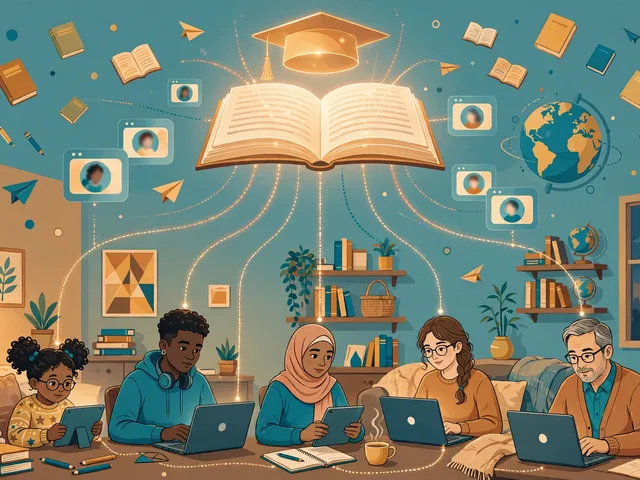
Put it all together, and the future of education looks like this: learning that is lifelong instead of front-loaded, personal instead of one-size-fits-all, and available anywhere instead of only in a few buildings. Teachers become guides and mentors. Classrooms become communities that meet both in person and online. And the qualification matters less than the skill it represents.
The students who thrive will not simply be those with the best technology. They will be the curious ones — people who keep learning, unlearning and relearning as the world changes around them. Online education cannot create that curiosity, but it can feed it, every day, for anyone with a connection and the will to begin. The classroom of the future has no walls. It is already open.
