Space Exploration
The Future of Space Exploration: Are We Ready for Mars?
For half a century, Mars has been the destination we always talk about next. Now rockets, robots and research are finally catching up with the dream — but readiness is about far more than getting there.
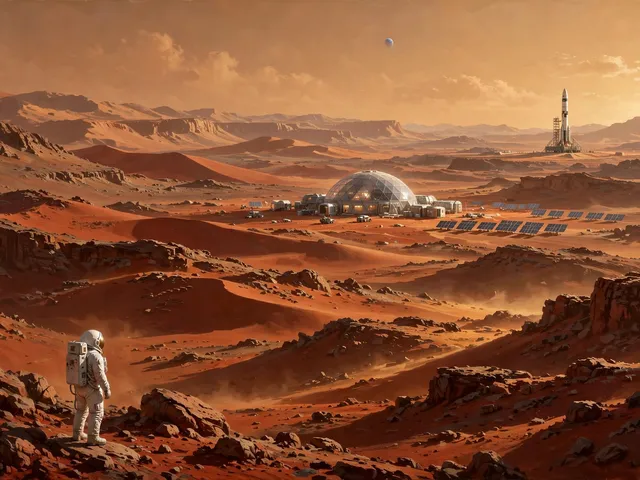
Look up on a clear night and you can sometimes spot it: a steady, rusty-orange point of light that does not twinkle like a star. Mars has fascinated us for centuries, but for most of that time it belonged to mythology and science fiction. That is changing now. Robotic rovers are driving across its surface today, helicopters have flown in its thin air, and the most powerful rockets ever built are being tested with one clear purpose in mind — to carry people there. The question is no longer whether humans will go to Mars. It is whether we are truly ready for what going there will demand.
Why Mars, and Why Now?
Mars is the most Earth-like world within our reach. A day there lasts just over 24 hours, it has seasons, polar ice caps, and evidence that rivers and lakes once flowed on its surface. Beneath its soil lies water ice, and its rocks may preserve clues about whether life ever began somewhere else. If we want to answer one of the biggest questions of all — are we alone? — Mars is the best place to look.
The timing is no coincidence. Reusable rockets have slashed the cost of reaching orbit, while advances in robotics, life-support recycling and lightweight materials have solved problems that seemed impossible a generation ago. Space agencies and private companies are returning to the Moon first, using it as a proving ground — every habitat, spacesuit and landing technique tested there is a rehearsal for Mars.
The Journey Itself Is the First Test
Getting to Mars is not like flying to the Moon, which takes about three days. Mars is, on average, more than 200 million kilometres away. A one-way trip will take roughly six to nine months, and because the planets must line up correctly for the return, a full mission could keep a crew away from Earth for two to three years. There are no rescue missions, no quick returns, and no real-time conversations with home — radio signals can take up to 22 minutes to travel one way.
That distance changes everything. Astronauts must handle medical emergencies, equipment failures and difficult decisions entirely on their own. Their spacecraft must recycle almost every drop of water and breath of oxygen, and shield them from cosmic radiation, which beyond Earth's magnetic field raises long-term health risks scientists are still working to reduce.

Living on a World That Tests Everything
Landing is only the beginning. Mars has an atmosphere less than one percent as thick as Earth's, so it offers almost no protection and no breathable air. Temperatures can fall below minus 80 degrees Celsius at night. Fine, abrasive dust gets into everything, and planet-wide dust storms can block sunlight for weeks, which is a serious problem if your power comes from solar panels.
A Martian crew will therefore need to live off the land. This idea, called in-situ resource utilisation, is already being proven: an experiment aboard NASA's Perseverance rover has successfully made oxygen from the Martian atmosphere. Future crews could extract water from underground ice, use it for drinking, growing food and even making rocket fuel for the journey home. Habitats may be buried under soil or built inside lava tubes for radiation shielding, and 3D printers could turn local regolith into spare parts and building materials.
The Human Factor Matters Most
Technology may not be the hardest part. Imagine spending years in a space not much larger than a small house, with the same handful of people, eating carefully rationed food, with no walk outside without a spacesuit and no possibility of coming home early. Studies in Antarctic stations, submarines and simulated Mars habitats on Earth show that isolation, confinement and monotony test even the most highly trained crews.
That is why future Mars astronauts will be selected as much for temperament, teamwork and resilience as for technical skill. Crews will need routines, exercise, meaningful work, private space and contact with family — even delayed. Growing fresh food, as crews already do on the International Space Station, helps nutrition and morale alike.

So, Are We Ready?
Honestly, not quite — and that is not a reason for disappointment. We are ready to begin in earnest. The rockets are nearly ready. The rovers have mapped landing sites and tested key technologies. What remains is the patient, unglamorous work: proving life-support systems can run flawlessly for years, solving radiation protection, practising precision landings with heavy cargo, and learning how crews cope on long, isolated missions. Robotic cargo flights will likely go first, delivering habitats, power systems and supplies before any person sets foot on the surface.
We will not go to Mars when it becomes easy. We will go when we have done the hard work of making it survivable — and that work is happening right now.
There are also bigger questions to settle together. Who governs a settlement on another planet? How do we protect pristine Martian sites from contamination by Earth microbes, and protect returning crews from anything they might bring back? These are not reasons to stay home, but they deserve thoughtful, international answers before the first crew departs.
What Mars Gives Us Back
Even before anyone lands, the push toward Mars is paying off on Earth. Water-recycling systems, medical monitoring, lightweight solar power, robotics and food-growing technology developed for space are already finding uses in hospitals, farms and remote communities here. And there is something less tangible but just as real: a Mars mission gives a generation of students a reason to study science, engineering and medicine, and gives all of us a shared goal that crosses borders.
So, are we ready for Mars? Not today, and not all at once. Readiness will arrive step by step — one test flight, one solved problem, one rehearsal at a time. But for the first time in history, the path to the red planet is visible, practical and underway. The generation that watches the first footprints pressed into Martian dust may already be in school — and that moment will be proof of what patient, cooperative, determined human beings can achieve.

No comments:
Post a Comment